Friday, 6 January 2017

Differing attitudes to a ‘language change’ issue

http://www.ted.com/talks/john_mcwhorter_txtng_is_killing_language_jk/transcript?language=en


  • "And so, the way I'm thinking of texting these days is that what we're seeing is a whole new way of writing that young people are developing, which they're using alongside their ordinary writing skills, and that means that they're able to do two things. Increasing evidence is that being bilingual is cognitively beneficial. "
  • Mixed opinions but generally positive connotations
  • Allowing us to write how we speak
http://www.prdaily.com/Main/Articles/4_ways_texting_is_killing_our_communication_skills_13330.aspx


  • Negative connotations
  • "Txtspk" leads to deficiencies in basic language skills. Shortcuts with spelling, punctuation and emoticons don't help children and teenagers learn the necessary writing and communication skills they need for college and the workforce."

Semantic shift - "Mouse"

"Mouse"

Noun


1. a small rodent that typically has a pointed snout, relatively large ears and eyes, and a long tail

  • Originated from the Sanskrit (an ancient Indian language) word for mouse "musuka" where "mus" means "thief" referring to the fact that mice steal food from humans.
  • The ancient Romans then used the word "mus" to refer to all rodents - example of borrowing and broadening as the old meaning is kept and new meanings are added
  • "Mus Maximus(big mouse)" Rat
  • "Mus Minimus(little mouse" Mouse


Noun
2. a small handheld device which is moved across a mat or flat surface to move the cursor on a computer screen.


  • The word "mouse" eventually was adopted to refer to a computer device in the 1960s.
  • Douglas Englelbart and Bill English had named it  a mouse because they though that the cord that comes out of the mouse resembled a tail - metaphoric change, based on similarity of thing
  • They also named the cursor a "bug" but this never caught on


Thursday, 5 January 2017

George reading essay: 'Young readers should be corrected whenever they make a mistake' - evaluate.

As expected, children make mistakes whilst initially learning to read, however these mistakes are more appropriately thought of as virtuous errors, as it is obvious why the child has made them. Overgeneralisation, a form of virtuous error, is where a child over applies a grammatical rule usually adding 'ed' to irregular verbs such as saying 'I runned' rather than 'I ran'. Whether these 'virtuous errors' should be corrected or not is a very controversial topic, some caregivers prefer to help children if they get stuck on a word where as others prefer to let the the child to solve their own problems. I will be identifying this argument in relation to various theories and the Text provided.


Children are taught to read in schools, using a method called 'synthetic phonics' which involves teaching letter sound correspondence, and then putting these sounds together to create words. We can see this approach is also used by the child's mother when he struggles to say the word 'sandbags' and she suggests to 'sound it out'. Despite this being initially successful George then pronounces it incorrectly again as 'sanbags'. The elision of the 'd' sound may possibly be explained as a consonant cluster reduction, where children are likely to find the production of a consonant cluster difficult, so they reduce them to smaller units. Noun compounds such as these are also a hard concept to grasp as a young reader. This highlights the idea that children have to be reminded several times before the word is more deeply processed and learnt suggesting that it is a good idea to correct a child every time  they get a word wrong to reinforce it allow them to learn the standard form. However in this instance we cannot see whether after the second correction George has gone on to pronounce the word 'sandbags' correctly.


Jerome Bruner developed the interactionist theory in which he said that language is not acquired simply through teaching, but more importantly through interaction between the child and caregiver and in order to do this the caregiver must use child directed speech or CDS. He identified several different traits of CDS that include: speaking more slowly, using a high degree of repetition and a frequent use interrogatives, all of which can be seen within the utterance 'what's happening (.) what do you think is happening (2.0)'. In this instance George's mother is clearly encouraging him to answer independently rather than just correcting him portrayed by the subjective pronoun 'you'. Arguably this could  be seen as a more effective way of learning to read as George will not become dependent upon his mother and hopefully this will allow him to be able to read in her absence. For this reason, together Vygotsky and Bruner developed 'scaffolding' the collective name for the strategies that caregivers teach children to aid their language development which may be a more suitable way of learning language as the child will then adopt these strategies and then use them when reading on their own. Despite a wide amount of evidence portraying the positive effect on child-caregiver interaction Bruner's theory has been challenged by refuting evidence and theory. Noam Chomsky believes that a child could not possibly learn language through imitation alone as a large proportion of the language spoken in their presence is highly irregular and sometimes incorrect.

George's mother praises George for pronouncing words correctly on various occasions with the use of phrases such as 'well done', 'good boy' and 'that's it' to promote this behaviour. She also uses praise  when he makes virtuous errors in order to encourage him to try again him and not knock his confidence. We can also see examples of positive reinforcement whereby the mother rewards the child with a positive outcome, identified by Skinner. When George makes the word guessing error by reading 'upstairs' rather than 'upset' his mother says 'no (.) it looks like upstairs doesn't it (.) but look at the word'. We may initially see this as negative reinforcement due to use of the negative participle 'no' although she rewards him for understanding that 'upstairs' and 'upset' are visually similar words. This is an notable factor when discussing the idea of correcting a child's language, as it is important to be sensitive as they may become discouraged if they do not feel as if they are making progress within their development of language.


As we can see, there are instances where correcting a child's language is very beneficial and will help them although there are evidently right and wrong ways of doing so. In spite of this I do believe that corrections are not always appropriate in order to make learning to read a more enjoyable and rewarding experience for children.

Monday, 12 December 2016

Children's writing

1. B.M. Kroll(1981)

 
Stage 1: Preparatory Stage
  • Masters the basic motor skills needed to write
  • Learns the basic principles of the spelling system
Stage 2: Consolidation Stage(Up to 6 years)
  • Child writes in the same way as they speak
  • Uses short declarative sentences which include mainly 'any' and conjunctions
  • Incomplete sentences as they don't know how to finish the sentence off
Stage 3: Differentiation Stage(Up to 9 years)
  •  Child becomes aware of the difference between speaking and writing
  • Recognises the different styles available e.g. letter
  • Makes lots of mistakes
  • Uses writing guides and frameworks to structure work
  • Writes to reflect thoughts and feelings
Stage 4: Integration Stage (12+)
  • Child develops a personal style
  • Child understands that you can change your style according to audience and purpose
2. Doctor Cathy Barclay (1996)

 
Stage 1: Scribbling stage
  • Random marks on page
  • writing and scribbling are accompanied by speaking
Stage 2: Mock Handwriting Stage
  • Writing and drawings
  • produce wavy lines
  • cursive writing
Stage 3: Mock letters
  • Letters are separate things

 Stage 4: Conventional letters
  • Usually involves writing the name as the first word
  • child usually puts letters on page but is able to read it as words

 Stage 5: invented spelling stage
  • Child spells in the way they understand the word should be spelt - own way
Stage 6: Appropriate/ phonetic spelling stage
  • Attach spelling with sounds
Stage 7: Correct spelling stage
  • Able to spell most words


Year 4: http://www.lancaster.ac.uk/fass/projects/lever/PROJECTS/41/xf41/XF4105.HTM
  • Phonetic/invented spelling 'magpiy' (magpie)
  • Unclear writing
  • Missed whole words
  • Note form
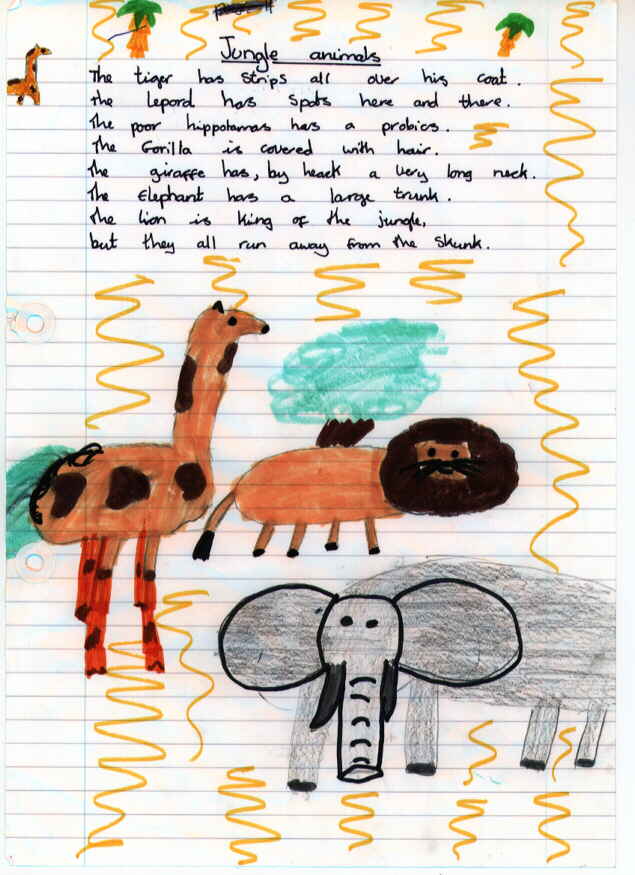
  • More pictures than words
  • Repetition of 'this is'
Year 5: http://www.lancaster.ac.uk/fass/projects/lever/PROJECTS/51/LK51/LK5104X.JPG
  • Simple sentences
  • Lots of adjectives
  • Commas
  • Still some spelling mistakes
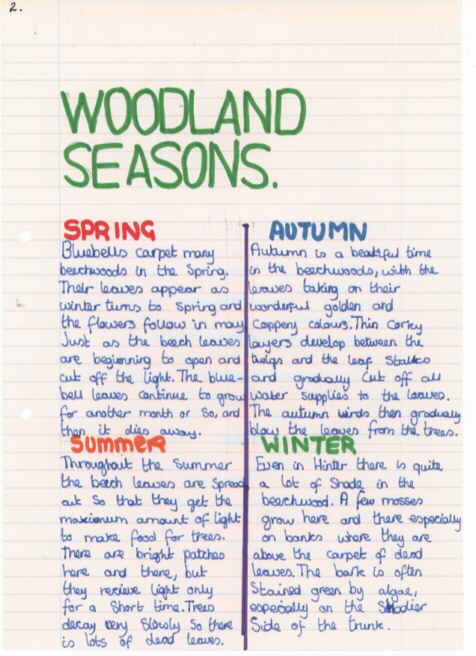
Year 6: http://www.lancaster.ac.uk/fass/projects/lever/PROJECTS/62/LK62/lk6203x.jpg
  • Separate Paragraphs
  • Wider variety of words
  • More complex lexis e.g. 'throughout' 'autumn'
  • Some misapplication of capital letters
  • Possibly copied from source 'Bluebells carpet many beechwoods'


Friday, 9 December 2016

Imitation and reinforcement are the most crucial tools for children's language acquisition - evaluate.

It is clear that on various occasions within the transcript Tom imitates his mother’s use of language. At the beginning of the transcript Tom's mother models the standard noun phrase "dad's bike" by recasting his utterance "dad bike" and then, after the use of self-correction, Tom then proceeds to use the standard form "dad's bike" throughout the rest of the transcript. The importance of this intercommunication between child and caregiver is identified as the underlying principle for Jerome Bruner's interactionist theory in which he also describes how the caregiver will adapt and simplify their language in order to help the child learn. We can also identify this child directed speech (CDS) within the transcript as the mother’s length of utterance considerably decreases when she says “dad’s bike” and other instances where her primary purpose is to correct Tom’s language and aid his development. As mentioned, we can see that on this occasion this suggests that a successful way of learning language is through imitation, although we cannot see if Tom has continued to use the standard noun phrase “dad’s” in the future as it is likely that the child will have to be reminded several times before it is finally reinforced. 

Despite this there are also instances where imitation does not occur. Tom makes the virtuous error of saying “it make noises” leaving out the third person singular inflection on the verb which his mother then reformulates to the standard form  “makes”. However, unlike the previous example Tom does not imitate this and simply replies with “yeah”. Arguably this “yeah” could imply that Tom has understood although it is likely that because his mother has simply echoed his previous utterance (other that adding the ‘s’ sound) he may not recognise that this is reformulation and may simply think she is agreeing. We can question the importance of imitation in child language acquisition for this reason. If language is learnt purely through imitation, then why do children make grammatical errors such as these? Naom Chomsky presents the idea that children could not possibly learn from imitation alone, as ‘the language spoken around them is highly irregular and sometimes ungrammatical’. He also believes that rather than social causes playing the primary role in language acquisition, children are born with an innate ability to learn language called a language acquisition device or LAD. It could be argued that Tom’s use of “make” rather than “makes” supports Chomky’s theory as it clear that he has not learnt this purely form imitation alone. 

B.F. Skinner produced his behaviorist theory in which similarly to Bruner he believes children are ‘empty vessels’ in which language has to be ‘put into’. His theory consists of the idea that correct utterances are positively reinforced by a rewarding outcome and this therefore enhances the child’s language development.  Further on in the transcript Tom asks “is these drawing Cartoon Network cup of Tea Mum” which the mother then replies with “um (.) no (.) it’s a moving shadow mug (.) it looks like the Cartoon Network logo (.) but it’s actually something else”. At first, we may perceive this as negative, rather than positive reinforcement as she uses the negative participle “no” although she does go on to give him what he wanted by answering his question which in this case acts as his “reward”. This supports the idea that as well as imitation, reinforcement also plays a role within CLA. 

However, Positive reinforcement like all other theories has contradicting theories and/or refuting evidence. Tom asks his mother, “Is dat your talker” which his mother then replies with “my talker? Yeah (.) that’s a tape recorder” congratulating his heuristic understanding of what the tape recorder does. The use of the positive participle “yeah” however, may confuse the child into thinking that what he has said is correct blurring the fact that it is a correction to the standard noun ‘tape recorder’ rather than simply a synonym for ‘talker’. Introducing the idea that perhaps reinforcement may not be the most effective way to progress the child’s understanding of language. Unlike previous theories about imitation, reinforcement and the contradicting idea that nature plays a larger role, there are other arguably more important ways of learning. Lev Vygotsky, a Russian psychologist introduced the idea that for children to actively learn language the role of social interaction alone is not enough. Together, Vygotsky and Bruner developed the concept of scaffolding whereby caregivers provide language strategies for learners that they can then use independently when the caregiver isn’t present. This seems like a more appropriate tool for children’s language acquisition, as the child does not then become reliant upon the caregiver always being there to correct their mistakes. 

It is clear that within the transcript and CLA that imitation and reinforcement play and important role although arguably they are not the most crucial tools and can be used alone. By looking at the transcript alone we cannot make any conclusions about these methods as we cannot see whether they have been effective or not in the future, we also cannot extrapolate the findings to every child as it is likely that everyone prefers to learn in different ways. 

Wednesday, 30 November 2016

Why is English so hard?

1. Defective orthography
English has a defective orthography meaning that the spelling of a word often has nothing/little to do with the pronunciation. This is often an issue for children learning to read(and write) as they are taught by letter- sound correspondence(synthetic phonics) but then they also must learn that the sound of a letter changes from word to word, for example the 'a' sound in 'hat' is pronounced differently than in 'hate'.


2. Irregular verbs
Children are often taught rules by adults to aid their understanding and be able to use them when they are not there, for example, 'to make a word past tense add 'ed'' however there are many exceptions to rules like these that often confuse children or people learning English. This rule applies to words like 'walk' and 'shout' but what about irregular verbs like 'hit' 'read' and 'think'. Children have to learn the rules but also when not to apply them.


3. The amount of words
English has a vast number of words – the biggest of any language, according to some scholars. It’s a particularly complex lexicon because it has many different roots and influences, including Old English and Latin, which means that there’s huge variety in how words are spelled.


4. Idioms and slang
As with most languages, spoken English tends to be more informal than written English, presenting further complexity for the student with the unenviable task of learning the language. Slang is yet another aspect of the language for learners to get to grips with, knowledge of which is necessary in order to understand informal conversation (a very basic example is “yeah”, which is slang for “yes”). English is also littered with idioms, which don’t always make sense to those learning English, but in order to speak English like a native speaker, a knowledge of idioms is essential. You’ll hear phrases such as “fat chance”, “turn a blind eye” and “call it a day” adding colour to everyday language, and it’s not just the phrases you need to learn, but their meanings and when it’s appropriate for you to use them.


5. There are so many silent letters
English has so many letters that aren't actually pronounced. “K”, such as “knife” or “knock”. There are also other silent letters at the beginning of words, such as the silent “H” at the beginning of “honour”, the “p” at the beginning of “psychology” or the “G” in “gnome”.


6. The order of the words
The difference between the right and wrong order is so subtle that it’s hard to explain beyond simply saying that it “just sounds right”. For example, we often use more than one adjective to describe a noun, but which order should they go in? We would say “an interesting little book” not “a little interesting book”. Both are technically grammatically correct, but the first “just sounds right”.


7. Homophones
English is full of homophones. E.g. 'A bandage is wound around a wound' 'the door was too close to the table to close' and 'I decided to desert my dessert in the desert'.


https://www.oxford-royale.co.uk/articles/efl-difficulties.html

Tuesday, 22 November 2016

How children learn to read

Who are the most popular children's authors and books? early years, infants and juniors. What makes them popular?


Puffin books
  • Each Peach Pear Plum by Allan Ahlberg - I feel that the rhyming and pictures are what make this text so successful. Children will enjoy the read and are most likely to find it easier because of the rhyming patterns. There are also hidden details in each picture to keep the child entertained.
  • The Snowman by Raymond Briggs  - I feel that the success of this book is down to the imagination it took to create and the amazing imagery that this book creates. Because of this Children will be able to imagine the scenery keeping them engaged in the book.
  • The Very Hungry Caterpillar by Eric Carle - I feel that the interactive element of this book is what primarily attracts children, this also makes this book very memorable and widely recognised. It also helps children learn about numbers, days of the week and time in a fun and imaginative way.
  • Where's Spot? by Eric Hill - Similarly to The Very Hungry Caterpillar I feel that the popularity of this book is down to the interactive element of lifting the flaps and finding and feeling as if they are finding spot themselves. It also teaches them about everyday objects.


  • The Tiger Who Came to Tea by Judith Kerr - The combinations of colourful illustrations and an enjoyable story make this a memorable book
  • Where the Wild Things Are - The somewhat 'naughty' child may humour the children and the imaginary magical wold with interest them.
  • The Gruffalo by Julian Donaldson - similarly to Each Peach the rhyming text with entice children to continue reading and the funny and almost slightly scary story will make it very memorable to t he child.
  • The Cat in the Hat by Dr Seuss
  • Biff, Chip and Kipper by Roderick Hunt - Designed to aid children's language development, used in 80% of schools in the UK
How are children taught to read?


1. Synthetic phonics
  • 'Phonics' involves teaching letter-sound correspondences. Children are then taught to 'synthesise' and put these sounds together to create words. Teachers will start of with single letter sounds (e.g. s,a,t,p,i,n) and then move on to those which involve 2 letters (E.g. oi, ou and ai) and so on.
  • “Learning the letter sounds is merely the first step. The really important bit is to teach the children what to do with them. How to blend them together for reading and how to listen for them in a word to spell it. Start simply with CVC words [consonant vowel consonant words, such as cat, hat, hop] and gradually introduce longer and more complex words.”
  • Irregular words such as those with origins from another language may be hard for the child to learn and may need other strategies to be able to learn these.
* Contradicting approach NLS 
  • Dr Kevin Collins came up the the Primary National Strategy(NLS) for learning how to read. He said that children might use their phonic knowledge to 'get the first consonant' but they also need to use the context, maybe the picture and the evolving story.

2. Reading schemes
  • Reading scheme books will be given to children in reception at varying stages. Some chose to do this right away, some after basic phonics have been learnt.
  • There will also usually be a reading diary designed for teachers to let parents identify any difficulties that their child might be having with reading.
  • Different schools have different schemes, some may let the child switch books whenever they please and some have strict policies that only the teacher can switch books on a certain day.
What sorts of 'miscues' (virtuous errors based on misapplication of reading skills) do young readers make?


  • "Whole word errors"- mistaking a word for another "similar looking word" often sight words e.g. simple - smile, every - very
  • "Word guessing errors" - children often only look at the first letter/few letters and then guess the word e.g. chart - chimp (read a book about a chimp so now says chimp for every word starting with 'ch'
  • "Tracking errors"- The words they say often contain the same sounds but are out of order e.g. no - on, form - from, left - felt
  • Blending error - noticeable 'choppy sounding' 
  • Letter confusion - Typically with visually similar letters e.g. b, d and p

How should caregivers deal with mistakes?
  • Some caregivers prefer to help children if they get stuck on a word where as others prefer to let them learn at their own speed and allow the child to solve their own problems.
  • Many people believe it is a good idea to help sound out the word rather than just reading it for them. 
Bibliography
http://www.booktrust.org.uk/books/children/booklists/241/
https://en.wikipedia.org/wiki/The_Magic_Key
http://www.huffingtonpost.co.uk/2014/08/14/reception-reading-how-your-child-will-learn-to-read-at-school-and-what-you-can-do-to-help-at-home_n_7331438.html
http://www.syntheticphonics.com/synthetic_phonics.htm
http://www.righttrackreading.com/errors.html